
Eyelid ptosis, also called blepharoptosis, occurs when the upper eyelid droops below its normal position. For some patients, ptosis mainly affects appearance, making the eyes look tired or uneven. For others, the drooping eyelid can interfere with peripheral vision, reading, driving, or daily activities.
At Fante Eye & Face Center, patients from Denver, Greenwood Village, and surrounding Colorado communities receive ptosis evaluation and repair from doctors with specialized training in eyelid function, eye health, and oculofacial plastic surgery. Dr. Robert Fante is double board-certified and a fellow of the American Society of Ophthalmic Plastic and Reconstructive Surgery, while both Dr. Levitt and Dr. Huang are ASOPRS-trained surgeons and ASOPRS Candidate Members. This focused expertise helps the team address drooping eyelids with attention to vision, eyelid position, symmetry, comfort, and appearance.
What Is Eyelid Ptosis?
Ptosis, sometimes referred to as blepharoptosis, is the medical term for a drooping upper eyelid. This condition can affect both vision and appearance, especially when the upper eyelid sits low enough to block part of the visual field. Ptosis affects approximately 5 percent of the population, and it becomes more common with age.
Eyelid ptosis can occur for several reasons. The most common cause is aging, in which the attachment of the eyelid-lifting muscle weakens over time. The muscle may still work, but its tendon no longer lifts the eyelid as effectively, causing the eyelid to droop. Some patients are also born with a congenital defect of the eyelid-lifting muscle, which can cause ptosis in childhood.
Droopy Eyelids in Children
Children that are born with drooping eyelids suffer from “congenital ptosis”, which is caused by issues in the muscle that lifts the eye. Additional symptoms of this disorder include asymmetrical upper eyelid creases. Children born with this condition tend to develop habits of lifting their eyebrows and tilting their heads backwards to make up for their vision impairment. In many cases of congenital ptosis, both eyelids begin to droop.
Droopy Eyelids in Adults
When adults develop Ptosis, it is due to the gradual weakening of the eyelids. Patients tend to exhibit difficulty reading and increased vision impairment.
Who Is a Candidate for Ptosis Surgery?
Patients may be candidates for ptosis surgery if a drooping upper eyelid affects vision, causes eye strain, creates eyelid asymmetry, or makes the eyes appear tired or partially closed. In some cases, visual field testing may be used to determine whether ptosis is interfering with peripheral vision.
Children with congenital ptosis may also need evaluation, especially if the drooping eyelid blocks vision or affects normal visual development. During your consultation, our doctors will examine eyelid position, muscle function, vision concerns, and overall eye health to determine whether ptosis repair is appropriate.
What Are the Symptoms of Ptosis?
The condition can be either unilateral (one side) or bilateral (both sides). When the drooping is mild, it may be barely noticeable and not impair vision. When severe, the upper eyelid can encroach upon the pupil, causing loss of peripheral vision (side vision). The central visual acuity, the vision necessary for reading an eye chart, is usually not impaired.
Ptosis is easily diagnosed. The obvious asymmetry of the droopy eyelids are a give away to this condition. However, there are some differences between Blepharoptosis in children and in adults.
How is Ptosis Surgery Performed?
A surgical procedure similar to blepharoplasty can be performed to repair drooping eyelids and restore a more natural shape and contour by adjusting or tightening the eyelid-lifting muscles. This operation often works for children as well, but some children require more complex surgery that uses the eyebrow-lifting muscle to help open the eye.
The procedure is usually performed under local anesthesia as an outpatient surgery, except for young children who require general anesthesia. Ptosis surgery typically takes less than an hour, and many patients can resume normal activities in about a week. The exact approach depends on the cause of ptosis, eyelid muscle function, age, anatomy, and whether one or both eyelids are affected.
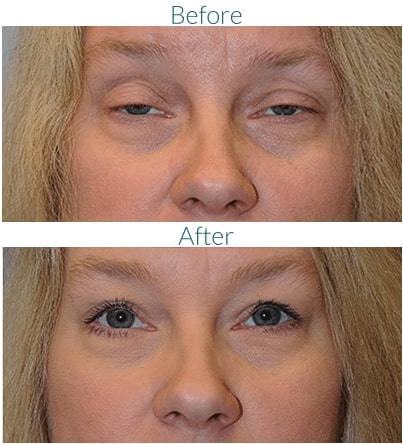
Droopy Eyelids Before and After Surgery
Read What Our Patients Are Saying!
Click here to read more reviews.
What is the Recovery From Ptosis Repair Surgery?
Most ptosis repair procedures cause some swelling, bruising, and temporary eyelid tightness. Sutures may require care during the first week or two. During this period, you should be able to see, move around, and complete many normal daily activities, but you may have visible bruising or a “black eye.”
Our doctors typically ask patients to avoid strenuous activities for the first week or two. You will receive specific instructions for travel, bathing, medication use, incision care, and post-operative activity. Healing depends on the type of procedure performed, your overall health, and how closely you follow pre- and post-operative instructions.
Most patients return to work in 7 to 14 days, depending on the extent of surgery, their occupation, and their comfort with being seen with bruising. Some smaller repairs may allow patients to return to work within 2 to 3 days.
Will Insurance Cover Ptosis Repair Surgery?
Your eye doctor performs a special test, a visual field test, to determine if the eyelid ptosis is affecting vision. In some cases, where there is vision obstruction, medical insurance may cover some or all of the costs for surgery. Some patients may also elect to have the surgery for cosmetic reasons. Children with ptosis usually need to have the eyelid(s) repaired to permit normal visual development, and for them, surgery is never cosmetic.
Are There Risks to Ptosis Surgery?
As with any surgery, ptosis repair has potential risks. These may include swelling, bruising, bleeding, infection, dry eye symptoms, scarring, asymmetry, overcorrection, undercorrection, difficulty closing the eye, or the need for revision surgery.
Vision-threatening complications are rare, but eye comfort and eyelid position are important considerations after surgery. Our doctors will review the risks specific to your procedure and explain what to watch for during recovery.
Alternatives to Ptosis Surgery
Ptosis surgery is often the most effective treatment when the upper eyelid droops due to weakness of the eyelid-lifting muscle or its tendon. However, not every patient with a tired or heavy eyelid appearance has true ptosis. In some cases, heaviness may be caused by excess upper eyelid skin, brow drooping, or a combination of concerns.
Depending on your evaluation, our doctors may recommend ptosis repair, upper eyelid surgery, brow lift surgery, observation, or additional testing for underlying medical or neurological conditions. During your consultation, the team will explain which option is most appropriate for your eyelid anatomy, vision, and goals.
Ptosis Surgery Consultation in Denver, Greenwood Village, Castle Pines and Highlands Ranch
If drooping upper eyelids are affecting your vision, comfort, or appearance, Fante Eye & Face Center can help determine whether ptosis surgery may be right for you. During your consultation, our doctors will evaluate your eyelid position, muscle function, vision concerns, and treatment options.
To book a ptosis surgery consultation with Fante Eye & Face Center in Denver, CO, serving patients from Greenwood Village, Castle Pines and the surrounding communities, call (303) 839-1616 today.